Want to Add Daily Games to Your Website? Here’s How to Start Small.


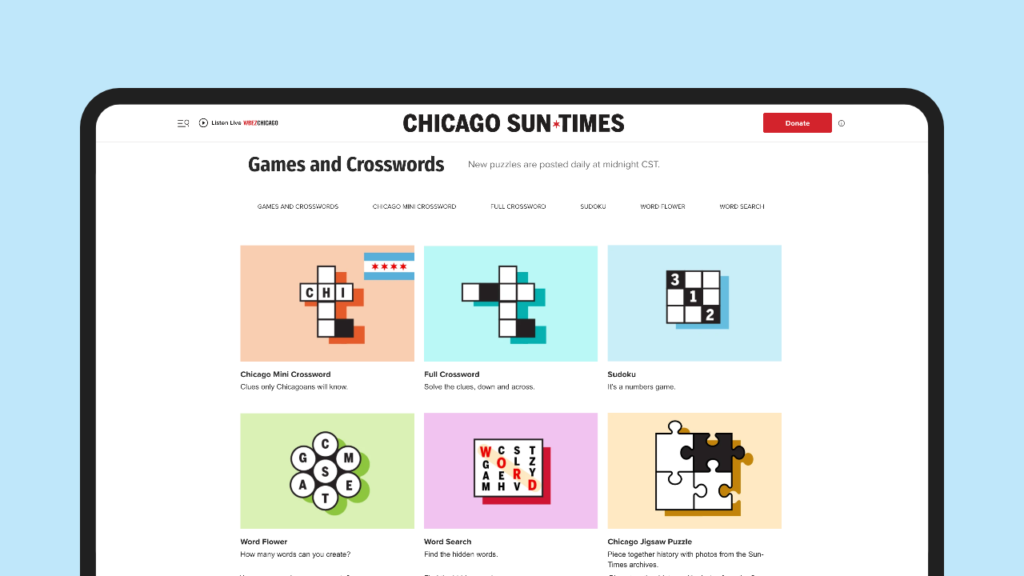


Getting readers to visit your website is one challenge. Giving them a reason to come back every day is another. Daily games can help bridge that gap:
However, there’s another side to running a successful games section: the operational demands on an already stretched staff.
The New York Times can afford a games team of more than a hundred people, including editors, constructors, designers, product managers, and developers. That’s not realistic for local and regional news publishers. So, how can you, as a small publisher, compete with the likes of NYT Games without the resources to match?
The good news is that you don’t need to.
With the right setup, you can give readers a polished, habit-forming games experience with a fraction of the effort. The key is to stop asking, “How do we build our own version of NYT Games?” and start asking, “Can we launch a games section that readers will want to return to?”
The idea is simple: build the smallest version of a product that solves the user’s problem, launch it, learn from real behavior, and invest further only where it makes sense. The same logic works surprisingly well for a games section. Your first version doesn’t need dozens of games or sophisticated features. You can start with a solid foundation that delivers real results from the beginning, and gives you the flexibility to scale as your audience grows.
To do that, you just need to get six fundamentals right.
The first step is to strike a balance between variety and simplicity. You want enough games to appeal to different types of readers, but not so many that managing your games section becomes an operational challenge.
A carefully selected mix of three to five games drawn from a stable of word, logic and image-based games, is a great starting point. Focus on accessible formats that your readers are already familiar with. For example, you could start with:
The idea is to see what your readers respond to the best. Depending on your publication, readers may gravitate toward particular types of games. For example, readers of a magazine that covers developments in the world of mathematics might respond better to logic games like Sudoku while a trivia magazine reader might respond better to quizzes and crosswords. However, it is always a great idea to throw an unusual game into the mix. You might be surprised by what catches on.
This may be the most important requirement of all. Games become habit-forming when readers know there will be something new waiting for them tomorrow. Even a single day without their favorite puzzle can disrupt a regular reader’s routine and leave a negative impression. This means your games section cannot depend on someone remembering to upload Tuesday’s crossword on Tuesday morning.
What you need is a reliable system that delivers fresh puzzles and games on a consistent schedule. For most local and regional news publishers, there are three main ways to approach this:
Work with freelance constructors to create puzzles for your publication or have staff create them as part of their job. This gives you access to quality content without a full-time team, although scheduling, uploading, quality checks, and day-to-day management remain your responsibility. Realistically, for most publications, this is too much to ask.
License puzzles from an established provider. This takes content creation off your plate, but depending on the provider, you may still need to handle digital publishing, branding, integration, and performance tracking. The problem with this approach is that it adds more work to your staff.
Work with a provider that supplies fresh puzzles on a set schedule and handles much of the publishing infrastructure. This can significantly reduce the daily workload while giving you more time to focus on engaging readers and growing your audience.
For example, Amuse Labs’ Puzzle Feed gives publishers access to a ready-made collection of daily games, including Mini Crosswords, Crosswords, Sudoku, Word Search, Word Flower, and more. All the puzzles are created by an editorial team and professional constructors. You simply choose the games you want, embed them on your website once, and the feed automatically updates with fresh puzzles every day.
For most smaller publishers, a solution like this is arguably the easiest and fastest way to launch and test a games section without adding more daily work to their in-house staff.
Whichever approach you choose, the goal is the same: give readers a reason to come back tomorrow, and make sure there’s something new waiting for them when they do.
Readers shouldn’t click from your homepage into your games section and feel like they’ve suddenly landed on a Coney Island like arcade.
Unfortunately, this can be a problem with traditional puzzle syndication services and free puzzle embeds. Some offer no control over how the games look and feel, while others introduce intrusive third-party ads that disrupt the user experience you’ve worked hard to create.
Your games section should feel like a natural extension of your publication, not a third-party add-on. At a minimum, you should have control over:
The games may come from a third-party provider, but the reader experience and the relationship you’re building through them, should remain yours.
Never undermine a worthwhile experiment with bad implementation. If your crossword loads on mobile but requires constant zooming, awkward typing, or fighting with the page, you’re not testing whether readers enjoy puzzles. You’re testing how much frustration they’re willing to tolerate to play one.
A seamless mobile experience is no longer optional. Major publishers are already adapting to a mobile-first world. Take The Guardian, for example. With 75% of its daily digital readers accessing content on mobile devices, the publisher redesigned its mobile app in May 2025, introducing a dedicated puzzles and games hub to make it easier for readers to discover and enjoy their favorite games on the go.
Your games section needs to work just as well on a smartphone as it does on a desktop. That means more than simply making sure a crossword or Sudoku puzzle fits on a smaller screen. Games should load quickly, be easy to navigate, and respond intuitively to touch, without forcing readers to pinch, zoom, or struggle with an on-screen keyboard.
A good puzzle with a bad interface is still a bad experience. When you’re trying to build a daily habit, every unnecessary tap, delay, or frustration gives readers one more reason not to return.
An experiment whose success or failure cannot be measured is hardly an experiment worth running. You need to understand what people are playing, what keeps them engaged, and, most importantly, whether your games are giving them a reason to return.
At a minimum, you should be able to answer questions like:
These metrics tell you whether your games section is doing what you launched it to do in the first place: building engagement, encouraging repeat visits, and ultimately contributing to reader retention.
If readers consistently abandon a particular puzzle halfway through, is it because the puzzle is too difficult? Is the interface frustrating? Is it simply not the kind of game your audience enjoys? Without analytics, you have no way of knowing where to start looking.
You shouldn’t have to guess whether your games are working, nor should you have to build an entirely separate analytics infrastructure just to find out. Analytics belong in your minimum viable games section, not in some hypothetical Phase Two. Without data, every decision is a guess. With it, you can identify what readers love, improve what they don’t, and make a much stronger case for investing further in your games section.
Your games section might start small, but as you attract more readers, introduce new games, and invest in growing your audience, you need a platform that can grow with you. The last thing you want is for your games section to become a victim of its own success. Slow-loading games, puzzles that fail to appear, or servers that struggle with traffic spikes can quickly undermine the experience you’ve worked hard to build.
That’s why reliability and scalability should be among your biggest considerations when choosing a games provider.
One way to evaluate a platform’s reliability is to look at who already uses it. A provider trusted by established publishers serving millions of players is more likely to have infrastructure that’s been tested under demanding real-world conditions. However, technical reliability is only part of the equation. Responsive customer support is equally important.
Before making a decision, ask potential providers about time to launch, uptime, support response times, how they handle technical issues, and their experience working with publishers of all sizes. Ultimately, you’re not just choosing a collection of games and puzzles. You’re choosing a technology partner your readers will depend on every day. Make sure it’s one you can depend on too.
Building a successful games section doesn’t have to mean building an entire games operation from scratch. The key is to start small, focus on what your readers enjoy, and choose a platform that can grow with you.
Choosing the right partner can make that process much easier. Amuse Labs, the platform powering games for everyone from local news outlets like Wausau Pilot & Review and Get The Coast to major publications like the Los Angeles Times and The Atlantic, offers a ready-made Puzzle Feed that brings together fresh daily games, customizable branding, built-in analytics, and reliable infrastructure.
With plans starting at just $99/month, launching a games section might be simpler than you think. Explore Puzzle Feed or get in touch with our team to see how it could work for your publication.
