
If you’ve spent any time on the New York Times website on a Friday, you’ve probably come across their weekly news quiz. The Guardian has one, and so does The Washington Post. CNN ties its quiz to the morning newsletter, and Bloomberg launched one focused entirely on finance.
News quizzes have become a serious engagement tool at the biggest publications in the world. And yet, surprisingly few local and independent publishers have followed suit despite having some of the most engaged, community-connected readerships around.
That gap is worth closing. Here’s why and exactly how to do it.
Why news quizzes are worth your time
News quizzes do something most content can’t: they turn passive readers into active participants. Research from the Center for Media Engagement at UT Austin found that readers who took quizzes tied to news and current events felt more informed and showed a stronger interest in continuing to follow the news (source). That’s the habit loop every publisher is trying to build.
The numbers from major publishers tell the same story. The Washington Post reported that a majority of their quiz players return regularly. Some as many as 30 times in a single month (source). The New York Times has found that subscribers who engage with both news and games in the same week have the strongest long-term retention of any subscriber segment (source).
For publishers thinking about reader loyalty, time spent on site, and subscription revenue, the news quiz quietly delivers on all three.
So why haven’t most local publishers done it?
Because running a news quiz consistently is genuinely hard work, and until recently, the math didn’t add up for most newsrooms.
Writing good quiz questions takes real editorial time. They need to be accurate, fair, and actually interesting to answer. Then someone has to review them, format them, and publish them. Then do it all again next week. And the week after. Without dropping the ball.
Some newsrooms write their own quizzes entirely. Others have looked into hiring a dedicated quiz writer or outsourcing it to a vendor. For most local and independent publishers, neither option is realistic. So the idea gets shelved, not because it wasn’t worth doing, but because the resources weren’t there.
That’s a completely understandable place to be. But things have changed significantly.
How AI news quiz creation has changed
While most independent publishers are missing out on the news quiz opportunity, major newsrooms are beginning to solve the production challenge with AI.
At Hearst Newspapers, the DevHub team built an AI-powered quiz engine called Emcee. What used to take a full day of editorial work now takes about an hour of review. Hearst now tracks the hours saved as a KPI and redirects that time back into reporting (source). TIME Magazine used AI to turn over 200 million words from its archives into engaging quiz content, what was once an enormous manual undertaking became something their team could sustain week after week (source).
Crucially, this isn’t just a big-publisher story anymore. Advance Local, an organization with news publications across Cleveland, Pennsylvania, Alabama, and more, uses the widely available PuzzleMe AI (easy-to-use, SaaS platform) to produce news quizzes on local politics, sports, and community stories across their network. Boston.com runs a weekly Greater Boston news quiz and occasional pop culture quizzes. The Indian Express in India publishes news quizzes alongside entertainment and current affairs formats.
Publishers like The Daily Memphian, Civil Beat, Lookout Santa Cruz, The SF Standard, and many others are already using PuzzleMe games for reader engagement.
The tools that were once only accessible to newsrooms with large product teams are now available to any publisher, regardless of size. The production barrier that made news quizzes impractical for most local newsrooms has effectively been removed.
The opportunity that’s wide open
Major publishers have been running news quizzes for quite some time now and the format has proven itself convincingly. Readers come back to the quizzes, habits form around them, and this creates an ongoing connection that regular articles rarely build on their own. For local and independent publishers, that’s encouraging news. The format has been tested, the reader behavior is well understood, and the playbook exists.
As a local or independent news publisher, you can run a quiz on city council decisions, town hall meetings, a sports season, or community events. You can link a short quiz at the end of every article you publish, keeping readers engaged with the story they just read. You can build themed quizzes around an election cycle, or a community issue you’ve been covering for months that your readers can’t get anywhere else. You can decide the cadence to be published: daily, weekly, monthly, or after every big story. Start with whatever fits your newsroom right now and build from there.
Your options for creating a news quiz
There are a few ways to approach this, and it’s worth understanding how the landscape has evolved.
The traditional approach is to write quiz questions manually and use a general-purpose tool like Google Forms to build and embed them. The challenge, as many publishers have found, is sustaining it. These tools weren’t built specifically for news. They don’t read from your articles and don’t match cleanly with your branding. Writing thoughtful quiz questions week after week is a real-time commitment on top of everything else a newsroom already has on its plate.
The way most publishers are doing it now is AI-assisted. Rather than writing questions from scratch, you give the tool your article, and it generates the quiz for you — questions, answer options, and explanations included. AI also picks up on culturally relevant details and context from an article that are easy to miss, and crafts genuinely interesting distractor options that make the quiz challenging rather than obvious. It can also generate different types of questions, like numerical, tone-based, and contextual ones, without any extra effort on your part. Your role shifts from creation to review and editing, which is a much lighter lift. This is how major newsrooms like Hearst brought their production time from a full day down to about an hour, and now local publishers can do the same.
PuzzleMe AI is built specifically for this workflow. Unlike general quiz tools, it’s designed for news publishers, which means the output format, embedding, branding, and distribution are all built with your use case in mind. Here’s how it works in practice.
Two ways to create an AI news quiz with PuzzleMe
There are two paths to creating a quiz, and the right one depends on how you like to work.
Path 1: The Quiz Builder
This is the most straightforward option. The interface handles the main decisions upfront. You set the number of questions, tone, and difficulty using built-in controls, so you’re not starting from a blank page. There’s also an additional instructions box where you can add anything specific: a particular angle, certain facts you want emphasized, or guidance on how the quiz should sound.
- Log in to PuzzleMe and go to Create Quiz Game → PuzzleMe AI
- Under the Generate quiz using AI, click on the Website option
- Paste your article URL in the Website Text box
- Set the number of questions, tone, and difficulty using the built-in controls
- Add any additional instructions in the Instruct PuzzleMe AI box
- Hit Create
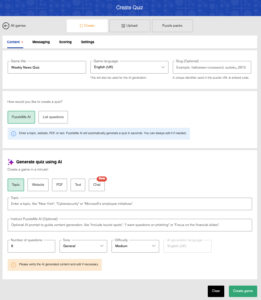
If your article is behind a paywall, use the PuzzleMe AI Chat option instead and paste the article text directly, add your settings, and generate from there.
Path 2: The Agent
The agent gives you more conversational control. Instead of working through a form, you’re talking to it directly, which means your prompt does more of the work. The more specific you are, the better the output.
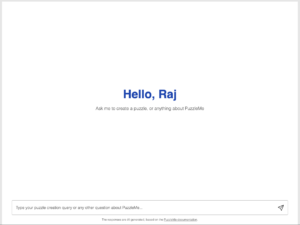
- Log in to PuzzleMe and click the PuzzleMe AI icon
- Paste your article link and
- Ask for a quiz with your full prompt, including tone, difficulty, audience, and angle
- The puzzle is created and ready for review. You can play the quiz, review, and ask for any changes
- Once done, add the puzzle to your account
Once your quiz is generated, preview it carefully. Read every question and every answer explanation. AI is fast, but your editorial judgment is what makes it yours. Edit anything that doesn’t feel right, add images if you have them, and apply your brand colors so the quiz feels native to your site.
Hit Publish, copy the embed code, and paste it onto your webpage.
Prompts that get better results
For the Quiz Builder’s additional instructions box – the UI already handles tone, difficulty, and question count, so use this space to add the specific flavor you want:
- “Focus on the economic impact angle of this story, not the political one.”
- “This is for a general local audience, avoid technical jargon.”
- “Write in a warm, community-focused tone that feels like it’s coming from a neighbor, not a broadcaster.”
- “Emphasize the human stories in this article, not just the facts and figures.”
For the Agent – since you’re working freeform, a complete prompt works much better than a short one:
- “Create a 5-question multiple choice quiz from this article [add link]. The audience is general readers in [your city] who follow local news casually. Use a conversational tone, medium difficulty, and include a brief explanation with each answer.”
- “Generate a weekly news quiz from these three articles [links] covering this week’s top local stories. Mix difficulty levels – a couple of easy questions to build confidence, a couple of harder ones to challenge engaged readers. Keep the tone light but informative.”
- “Build a themed quiz about the local election coverage from this article [add link]. 6 questions, hard difficulty, suitable for readers who have been following the race closely. Tone should be serious and journalistic.”
And quizzes are just the beginning
Once you’re up and running with news quizzes, PuzzleMe AI opens up a lot more. Crosswords, Word Search, and many other puzzle formats can be built from your content.
You don’t need to think about all of that on day one. Start with a quiz. But it’s worth knowing that you’re not just adding one new format, you’re building an engagement layer that can grow alongside your publication for the long run.

- AI News Quiz for Local and Independent Publishers: It’s Never Been Easier - March 20, 2026
- Add PuzzleMe Games to Your Newsletter (Technical Guide) - March 9, 2026
