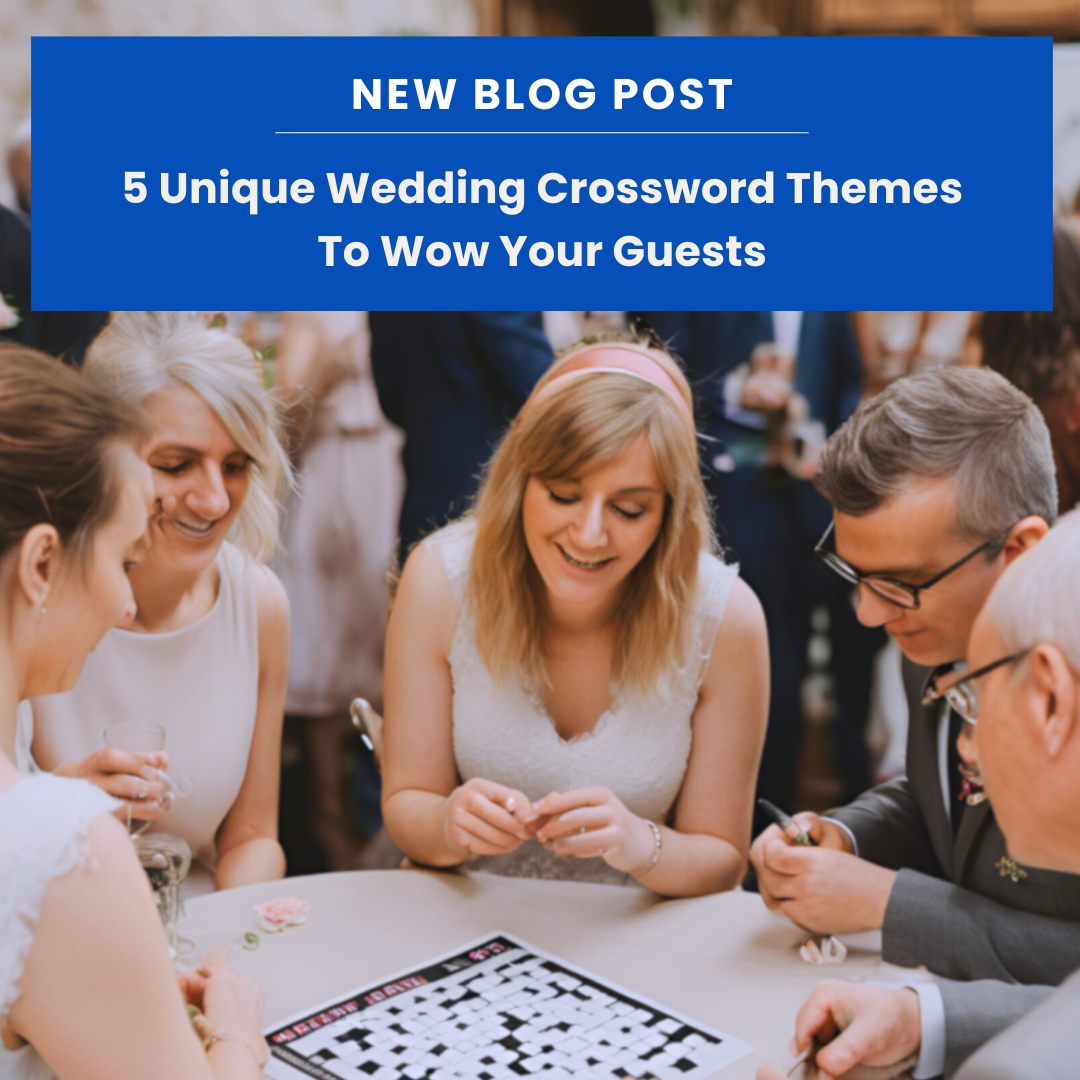
5 Free Wedding Crossword Templates To Wow Your Guests

Are you looking for a fun and engaging way to entertain your guests at your wedding reception or bridal shower? Look no further! While there are many games you can incorporate, a wedding crossword is a unique way to add a touch of personalized fun without building on your million responsibilities. These puzzles not only keep your guests entertained but also create lasting memories.

Why Wedding Crosswords?

Imagine your guests mingling and bonding over clever clues that reveal fun facts about your love story, favorite travels, or shared interests. A wedding crossword puzzle serves as an icebreaker, conversation starter, and a delightful activity that guests of all ages can enjoy. Plus, it’s a keepsake that they can take home, reminding them of your special day long after the celebrations are over.  

Don’t believe me? Hear how everyone loved wedding crosswords at this reddit user’s wedding!

Comment
byu/Pie-Burglar from discussion
inweddingplanning

Does this sip and solve sound good? Let’s wow your guests!

5 Free Wedding Crossword Templates

Let’s explore five free templates for your wedding crossword puzzle that will surely wow your guests. Worry not, we have readymade wedding crossword questions!

1. Your Love Story
What is better than starting by celebrating love. Create a crossword puzzle for your bridal shower or wedding reception with interactive clues about the significant moments and shared interests in your relationship journey.

This personalized touch will surely warm the hearts of your guests and make the crossword puzzle extra meaningful.

Example Wedding Crossword Questions:

  1. We met here for the first time
  2. The month we got engaged
  3. Ms. Y’s favorite animal
  4. Guess the wedding cake flavor
  5. Our favorite sports team
  6. The proposal location
  7. Maid of honor’s name
  8. The song we consider ‘our’ song
  9. Our first vacation together
  10. The name of our favorite restaurant

Answers: You Choose!

2. Wedding Trivia

Infuse your wedding festivities with fun and entertainment by challenging your guests’ knowledge of the love business through an engaging wedding trivia crossword. With interesting and lighthearted questions about wedding customs and traditions, add an interactive and enjoyable dimension to your celebration. Moreover, you can personalize it according to your culture and unique traditions. 

Example Wedding Crossword Questions:

  1. Which hand is the wedding ring traditionally worn on
  2. What is the traditional gift for a 25th wedding anniversary
  3. The month historically considered the luckiest for weddings
  4. A wedding tradition where the groom carries the bride over this to enter their home
  5. The name of the party thrown for a bride-to-be by her friends and family
  6. This flower is often associated with weddings and symbolizes love and beauty
  7. This item is traditionally worn by brides for good luck, along with something old, new, and blue
  8. This is how a wedding bouquet toss is done
  9. The first dance between the bride and groom is called this
  10. This word refers to a formal promise or oath made by the couple during the ceremony 

Answers: 1. Left 2. Silver 3. June 4. Threshold 5. Bridal shower 6. Rose 7. Borrowed 8. Backwards 9. First Dance 10. Vow

Enough Clues? Put these clues and make a crossword for free!

3. The Fictional Favorites

Imagine a wedding crossword that takes your guests on a journey through the greatest couples of all time. From Romeo and Juliet to Jack and Rose, you can incorporate famous romantic literary/movie/tv shows into your crossword clues. Not only does this add a touch of nostalgia, but it also serves as a great conversation starter. 

Example Wedding Crossword Questions:

  1. This Shakespearean couple met a tragic end.
  2. The one that got saved on a floating wooden board, a flower.
  3. The New York guy who was ‘on a break’ in a sitcom about friendships.
  4. The estate where Elizabeth Bennet first met Mr. Darcy in ‘Pride and Prejudice’ 
  5. The family name of the vampire Bella Swan marries in ‘Twilight” 
  6. Bridgeton S2’s Daphene and __
  7. The place where Allie and Noah shared their iconic kiss in ‘The Notebook” 
  8. The publication Lois Lane works for, where she meets Superman. A heavenly object.
  9. Spice, Tony’s love interest
  10. Season when Jack and Amy got married in B99

Answers: 1. Romio & Juliet 2. Rose (from Titanic) 3. Ross 4. Pemberley 5. Cullen 6. Simon 7. Dock 8. Planet (The Daily Planet) 9. Pepper (Potts) 10. Fall

Using fictional favorites as a theme for your wedding crossword puzzle questions can evoke a sense of romance that resonates with guests of all ages.

Try a F.R.I.E.N.D.S crossword here:

4. Romantic Destinations

If you and your partner are avid travelers, why not incorporate your favorite destinations into a wedding crossword? Create a crossword puzzle with clues about romantic destinations worldwide. Personalizing your wedding crossword puzzle with travel-related clues allows you to share your love story uniquely, while also inspiring wanderlust among your guests. 

Example Wedding Crossword Questions:

  1. This city is known as the City of Love.
  2. We got engaged on this tropical island.
  3. Las Vegas venue for quickie weddings 
  4. A wonder of the world built in memory of love
  5. Island in Greece, symbol of sapphism
  6. Gondola-filled city
  7. Renaissance romance
  8. Tuscan town featuring in romantic novels 
  9. Island of the Gods
  10. Cherry blossoms in spring

Answers: 1. Paris 2. Personalize it 3. Chapel 4. Taj 5. Lesbos 6. Venice 7. Rome 8. Seina 9. Bali 10. Kyoto

5. Music Memories

wedding crossword free

Set the tone with a music-themed crossword! From the first dance to your favorite road trip songs, music plays a significant role in many relationships. Use song lyrics, artist names, and album titles to craft your crossword.

Example Wedding Crossword Questions: 

  1. This song by Ed Sheeran is a popular choice for first dances.
  2. Who sang ‘Endless Love’ with Diana Ross?
  3. “All You Need Is ___” Beatles hit
  4. Our first dance song
  5. Queen B of pop music
  6. Taylor Swift wrote about this place in 1989
  7. What rock icon was the founder of The Society for the Prevention of Cruelty to Long-haired Men?
  8. First name of classical composer who was deaf?
  9. Which Super Bowl Halftime Show performer was upstaged by a dancing shark?
  10. Lady Gaga affectionately call her fans, little 

Answers: 1. Perfect 2. Richie (Lionel Richie) 3. Love 4. Personalize it 5. Beyoncé 6. NewYork 7. Bowie (David Bowie) 8. Ludwig (Ludwig van Beethoven) 9. Perry (Katy Perry) 10. Monsters

Music-themed wedding crossword clues can evoke emotions and memories, making your puzzle both fun and sentimental.

Crosswords For Your Proposal!

Crosswords are very versatile and customizable. You can use it for a morning brain jog, your wedding or even for a unique proposal! Check out this heartwarming story of a crossword proposal: 


View this post on Instagram


A post shared by Indian Express Puzzles & Games (@iepuzzles)

Personalize Your Wedding Crossword

For sure, crosswords are a unique addition to any event. Especially adding these crossword templates to your wedding or bridal shower will make it a fun and unforgettable occasion for your guests.

But picture having all these themes in a single crossword, where you can customize each clue. These personalized puzzles will add even more magic to your special day. While making this may seem exhausting, we have an easier way for you! 

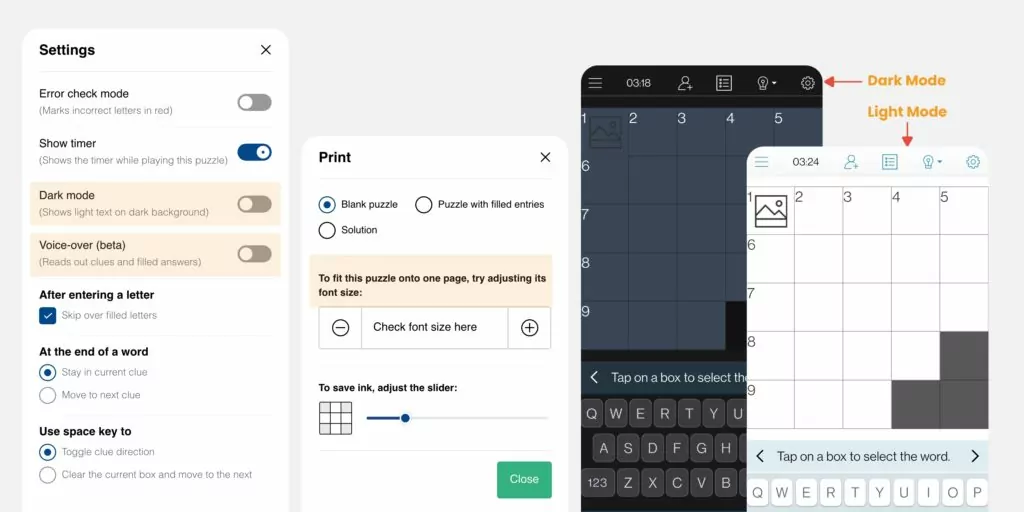
Check out PuzzleMe for creating personalized crosswords in no time. Make, Print, and Play with easy wedding crossword templates. Be it a personalized crossword, a unique theme crossword, or both, you can effortlessly generate wedding crossword questions with PuzzleMe’s AI Crossword Generator.

And for those looking to display their puzzle in a grand way, PuzzleMe also provides the option to export the puzzle in an SVG format. It makes printing large posters easy which can then serve as a unique decor element or a collective activity for guests.  

Make your wedding worry-free yet extraordinary today!
Want to make your wedding special?

24 Tips for Writing Crossword Clues from an NYTimes Constructor

Writing crossword clues is a very exact business. Clues need to be entertaining, factually correct, and phrased so that solvers know what they’re asking for — all in the space of just a few words. 

 So where does one go to learn the rules of writing crossword clues? That question arose years ago on a now-defunct New York Times crossword forum, and nobody had an answer. In an attempt to remedy the situation, I came up with the list of 24 rules below. It’s not the final word on the matter, but it does address most of the main issues.

 If you’re looking for even more info about crossword clues, you’ll find the subject addressed in these publications: 1. Patrick Berry’s Crossword Constructor’s Handbook; 2. Matt Gaffney’s The Complete Idiot’s Guide to Crossword Puzzles & Word Games; 3. The NYT Crosswords to Boost Your Brainpower (with solving and cluing tips from Will Shortz and Frank Longo); 4. Sage Advice on cruciverb.com (some cluing discussion); and 5. Amy Reynaldo’s How to Conquer the NYT Crossword Puzzle (although that’s more about solving than cluing).

1. NUMBER: If the answer is plural, the clue is plural.

2. PARTS OF SPEECH: If the answer is a noun, the clue is a noun. For verbs, if the answer is intransitive, the clue is intransitive.

3. TENSE: If the answer is in the past tense, the clue is in the past tense.

4. FOREIGN: If the answer is French, the clue is French or has a French reference.

5. SLANG: Generally speaking, a slang answer will have a slang clue (and eras must match). But there are three basic categories of words — standard, informal, and slang — and a clue can often move one category without further hint. This rule might be less strictly applied in more difficult puzzles.

6. ABBR.: If the answer is an abbreviation, a common way of handling the clue is to use an abbreviation somewhere in it (especially a word that is not commonly abbreviated). Another way of cluing an abbreviation (especially in easy puzzles) is to use an “(abbr.)” tag at the end of the clue. Note: Acronyms or initialisms that are more commonly abbreviated than not, such as U.S. or NFL, won’t usually signal an abbreviation in the answer. Likewise, in other than easy puzzles, RSVP as an answer doesn’t need to be signaled as an abbreviation in the clue, since no one spells out RSVP.

7. SHORTENED WORDS: An answer that’s a shortened form of a word will be signaled in the clue. For example: “May race, for short” for INDY. “Briefly” or “familiarly” are similarly used as tags. This rule can sometimes be ignored in more difficult puzzles.

8. SUBSTITUTION TEST: The clue must be able to be used the same way in a sentence as the answer. For example: “Started ahead of time” for JUMPED THE GUN. Substitution test: He started ahead of time in the race; He jumped the gun in the race.

9. DIFFICULTY: An obvious answer for a Monday clue will probably be right. An obvious answer for a Saturday clue will probably be wrong.

10, PARENTHESES: “(up)” at the end of a clue indicates “up” follows both the clue and answer. For example: “Liven (up)” for PERK. A parenthetical word or phrase might also provide additional information, such as a synonym for the answer, “Play to ___ (draw)” for A TIE, or a further explanation, “Lhasa ___ (dog breed)” for APSO.

11. ?: A question mark after a clue indicates wordplay or trickery is afoot.

12. KIND OF/TYPE OF: MEAL might be clued as “Kind of plan.” Even though a meal isn’t a kind of plan, “meal plan” is a common phrase. In effect, the clue is using “kind of” instead of a blank: “___ plan.” Some editors will never use this kind of clue, considering it awkward.

13. MULTIPLE WORDS: In many puzzles, answers that are phrases of two or more words are not signaled in the clue. It’s up to the solver to discover this. In easy puzzles, “(2 wds.)” will be used at the end of the clue.

14. QUOTES: A phrase in quotes signals the answer is a similar, spoken phrase. For example, “Can’t be done!” for NO WAY.

15. QUALIFIERS: Clues often use words or phrases as a tag to indicate the clue wouldn’t always be true for the answer. Examples: sometimes, usually, occasionally, of a sort, perhaps, in a way, for one, etc.

16. e.g.: If the clue is an example of the answer, rather than a description, “e.g.” is used. For example: “Atlantic, e.g.” for OCEAN. Similar tags such as “say,” “for example,” and “perhaps” also signal that the answer is more general than the clue.

17. AS: “Use, as an ax” for WIELD gives a bit more context than just “Use.”

18. NAMES: When a clue asks for the name of a person, the answer is the last name (or sometimes the full name). If the person’s first name is being asked for, there must be a signal in the clue, such as including the person’s last name, the first name of a role he/she played, or the first name of a costar.

19. MYTHS: If a clue uses a disputed fact, a tag such as “supposedly” or “they say” is used.

20. VAR.: If you see “Var.” at the end of the clue, prepare for cringing. This is an indication that the constructor and editor couldn’t find a way around using a variant spelling. Luckily, this is rare these days, but the good news is that it’s probably also an indication that there’s really nice stuff nearby in the grid to make up for it.

21. REPETITION: An answer word won’t be used in its own clue. Generally speaking, no answer word from the entire grid will be used in any of the clues, except for common words like THE, OF, AND, and so on. The same answer word won’t appear twice in the same grid, although sometimes small parts of answers, such as ON, might appear more than once. These rules do vary depending on the editor and circumstances.

22. WITH: In a clue such as Become understood, with “in”, the answer needs “in” after it to fit the clue. In this case, the answer is SINK, since sink in = become understood• A clue such as “Word with tea or ground” is looking for a word that either precedes or follows both words. Possible answers: BALL can follow both; HIGH can precede both. In easier puzzles, the clue will likely use the more definitive “before” or “after” instead of “with.” • A clue tag such as “with 22-Across” means the answer continues and the end of it appears at 22-Across.

23. BRACKETS: A clue contained within brackets indicates a non-verbal answer. For example, [Uh-oh!] could be a clue for GULP, as opposed to “Uh-oh!” (in quotes), which might clue YIKES. Likewise, [What a dreamboat!] is a clue for SIGH. Think of these clues as interpretations of what a sound or gesture might mean.

24. ARTICLES: Although articles are usually not used at the beginning of a clue — such as “Australian bird” for EMU, rather than “An Australian bird” — articles should be used in the middle of a clue. For example, KIWI should be “Fruit with a fuzzy skin,” not “Fruit with fuzzy skin.” An exception to the no-article-at-the-start rule is “A Great Lake” for ERIE, since there are five choices.

Starting A Crossword Puzzle Blog: The Complete Guide for 2024

Are you thinking of finally starting your crossword puzzle blog? Whether you’re a new constructor or would just like editorial freedom over your puzzles, a blog is a great way to publish in a low-pressure environment.

I’m Nishant, and I recently set up the India Mini crossword blog on WordPress. In the process, I encountered many challenges and discovered interesting things about starting a crossword puzzle blog. In this guide, I’m sharing some learnings from the experience.

Why Start a Crossword Puzzle Blog?

This is the first question you should answer: what am I looking for with a crossword puzzle blog? Starting a crossword puzzle blog can serve multiple purposes. It can be a platform for sharing your passion, a community hub for fellow enthusiasts, and even a source of income through subscriptions, advertising, and partnerships. Every decision henceforth will be based on your goals. For example:

  • If it’s a hobby, it would be best to choose free options for a blogging platform and a tool for creating your crosswords. Design and statistics also won’t matter to you that much. You could set up such a blog relatively quickly.
  • If it’s a venture, or could potentially be one in the future, you might want to publish ads or sell subscriptions to your crosswords. This is where the choice of platforms and design decisions end up mattering quite a bit.

So start by deciding what you want out of the project.

Finding Your Niche

The next step in starting your crossword blog is to find your unique angle. The world doesn’t need another generic set of puzzles, and you might have trouble getting traction for your blog without the right niche.

Thankfully, the crossword community is diverse, with interests ranging from casual puzzles to cryptic challenges. Your blog could focus on a particular type of crossword, such as American-style, cryptic, or thematic puzzles. Alternatively, you could cater to a specific skill level, from beginners to advanced solvers.

With the India Mini crosswords, for example, I set up a blog only for solvers who are aware of the Indian context. Find the niche you’d like to cater to and get started.  

Setting Up Your Blog

1. Choose a Crossword Platform

Start by choosing a platform to construct and publish your puzzles. We, of course, recommend PuzzleMe here. (Full disclosure: We are the creators of PuzzleMe). It’s the most powerful crossword puzzle maker and offers a polished experience for your solvers. The best part is that it’s entirely free for non-commercial users. If you’re doing this as a hobby, it’s a great option to consider.

Revered crossword constructors like Will Nediger, Paolo Pasco and Mangesh Ghogre use PuzzleMe to add crosswords to their blog. Check out a list of popular constructors and links to their blogs here.

2. Set Up a Blog

There are several blogging platforms to choose from, such as WordPress, Blogspot, Wix, and Squarespace. Each offers various customization options and ease of use. Keep in mind, though, that the free WordPress.com plan does not allow iframe embeds. 

For the India Mini, we used a combination of a paid WordPress plan and Elementor to build the site.

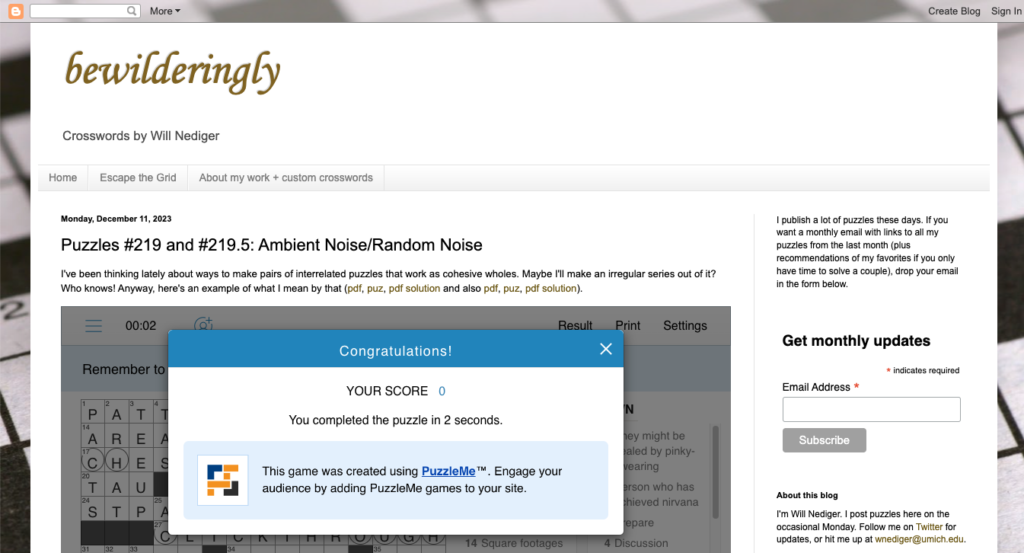
If you’d like to create a free blog without much hassle, Blogger is a great option. The benefit of using Blogger is that you could publish your writing, have a nice About page, and add your crosswords to the same website. Will Nediger’s crossword blog runs on Blogger. You can see what that looks like here.

Screenshot of Will Nediger's Blog

Design and User Experience

Your blog’s design should be clean and navigable, ensuring that visitors can easily find and solve puzzles. Thankfully, PuzzleMe takes care of this to a large extent for you. If you have any trouble embedding your puzzles into your blog, you can get in touch with us at support@amuselabs.com. 

Content Creation

Content is king in the blogging world. For a crossword blog, this means a steady stream of puzzles. You can create puzzles yourself using PuzzleMe. Magic Fill in particular is a feature that’s useful for building mini-puzzles. All you have to do is select the size of your grid and the words you would like included, and Magic Fill will find possible fill options for your puzzle. 

Building an Audience

SEO and Keywords

To attract visitors, your blog needs to be visible on search engines. Research keywords related to crosswords and incorporate them into your blog posts, titles, and meta descriptions.

For the India Mini crossword, the important keywords include ‘small crosswords’ and ‘Indian crosswords’ among others. You can learn how to use Google’s keyword planner to find relevant keywords for your niche. 

Social Media and Community Engagement

Leverage social media platforms like Twitter and LinkedIn to share your content and engage with the crossword community. Join crossword forums and groups to participate in discussions and promote your blog.

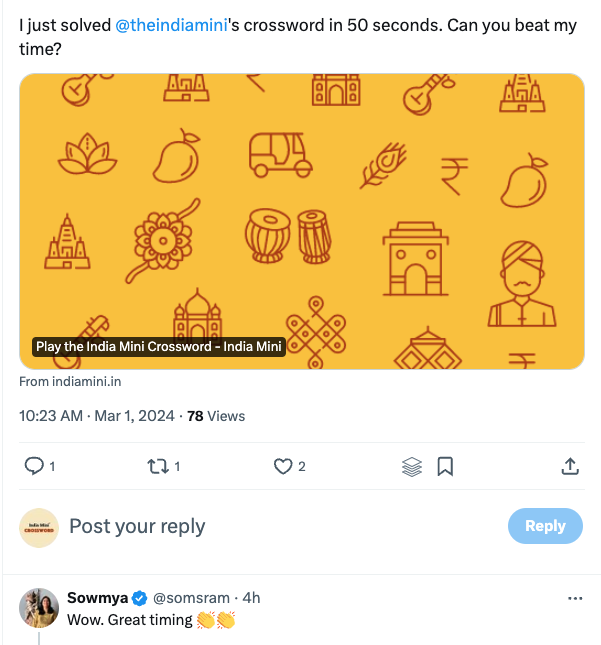
By default, PuzzleMe nudges your solvers to post their results on social media. When they do, you can interact with their posts to boost visibility.

India Mini crossword on Twitter

Email Marketing

An email newsletter can be a powerful tool for building a loyal readership. Collect email addresses from your visitors to keep them informed about new puzzles and posts. To make sure your newsletter reaches the right audience and delivers relevant content, it’s essential that the information you collect is accurate and complete. If you are collecting their information through HubSpot CRM, implementing HubSpot form validation will help verify email addresses and other form inputs, ensuring that your subscriber list is reliable and your campaigns are more effective. If you’re using PuzzleMe, it’s easy to collect names and email addresses at the start of your puzzle. See the video guide to set this up here:

Push Notifications

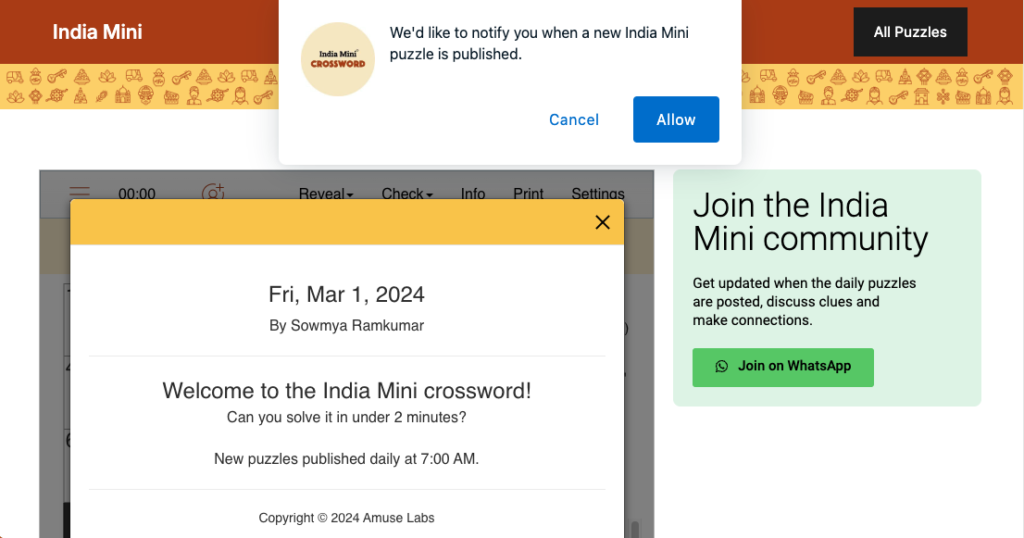
Another great way of reaching your solvers is through push notifications. For this, you can use a service like OneSignal. Follow the instructions on their website to add OneSignal to your website, and it’ll start prompting your solvers to sign up for notifications.

Once you have a significant number of sign-ups, you can send a push notification each time you publish a new puzzle. The best part is that this doesn’t require collecting any information regarding your solvers.

Notification popup on crossword puzzle blog

Monetizing Your Blog

Once you have a steady flow of traffic, you can explore monetization options. These can include:

  • Advertising: Display ads on your blog through networks like Google AdSense. Keep in mind that this requires scale, as most ad programs require that you have at least 50,000 visitors over the past month to qualify to run ads. 
  • Affiliate Marketing: Partner with puzzle book publishers or apps and earn commissions on sales. Mangesh Ghogre, for example, uses the puzzles on his website to promote his crossword book. 
  • Subscriptions: Offer premium content or ad-free solving experiences for a subscription fee. Plenty of such options have emerged, like The Puzzle Society. 
  • Merchandise: Sell crossword-themed merchandise such as mugs, t-shirts, and books. You can include links to the content you’d like to sell in the end-message of your puzzle. 

Track your analytics

With PuzzleMe, you get a lot of useful data about your solvers. You get to know what percentage of them completed a puzzle, how many times your puzzle was played, and even a heatmap of how difficult solvers found your clues. 

Screenshot of the Analytics Dashboard of Quiz to all users of PuzzleMe. The PuzzleMe analytics dashboard helps in tracking and optimizing quizzes.

Conclusion

Starting a crossword puzzle blog is an exciting journey that blends creativity, community, and technology. You can turn your love of crosswords into a thriving online hub by offering engaging content, a user-friendly experience, and a personal touch.

Remember, the key to a successful blog is passion. If you love what you’re doing, it will shine through in your content, and your audience will grow. So, set up your domain, create your crossword puzzle, and step into the world of crossword blogging. Happy puzzling!

Crossword Clue Examples: 10 Types of Crossword Clues with Examples

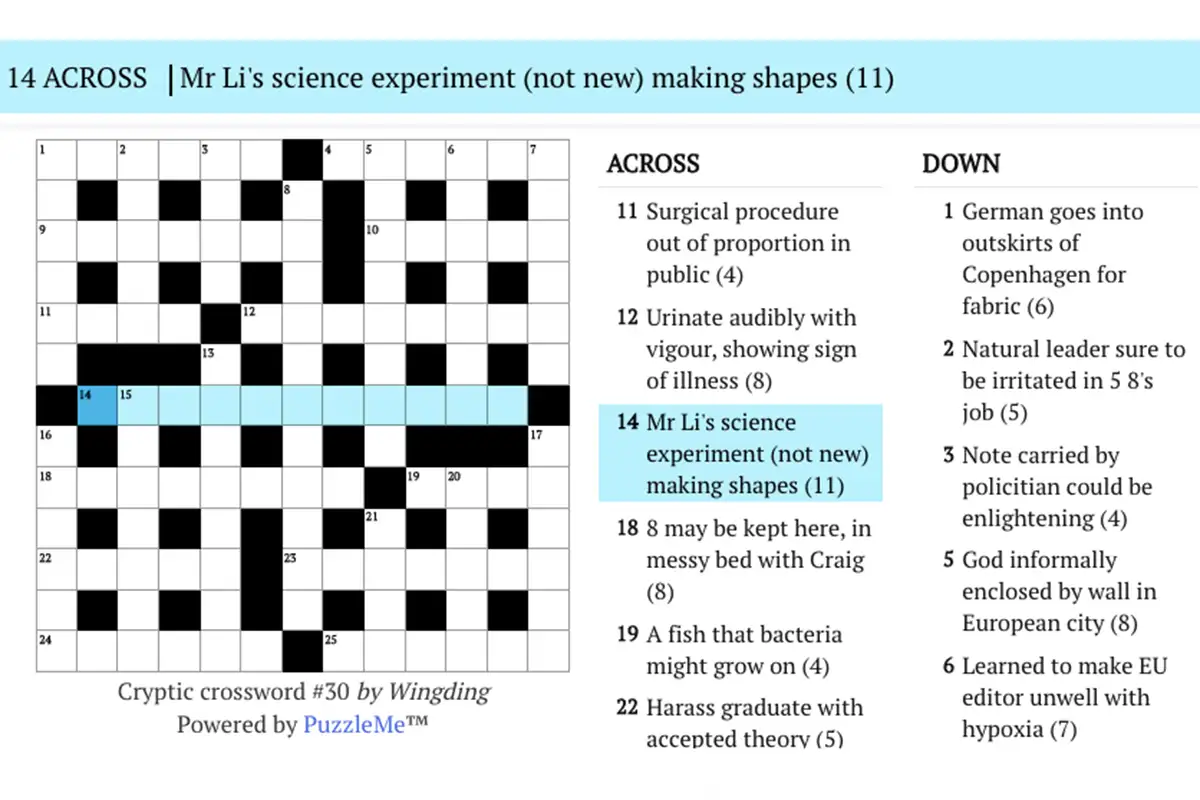
Crossword Clue Examples: Cryptic Crossword Examples

Introduction

Crossword puzzles have captivated minds for generations, offering both entertainment and cognitive exercise. Whether you’re a seasoned solver or a newcomer, understanding the different types of crossword clues can significantly enhance your solving experience.

In this blog post, we’ll delve into ten types of crossword clue examples, including cryptic crossword examples and cryptic clue examples, to help you become a crossword aficionado.

1. Simple Clues

What Are They?

Simple clues are straightforward. They offer a clear definition of the word you’re supposed to find.

Example:

    • Clue: ‘Feline pet’ (3)
    • Answer: CAT

The clue directly describes the word “CAT,” which is a feline pet. There’s no ambiguity or trickery involved.

Simple clues serve as the foundation for more complex clue types. They’re perfect for beginners and offer a quick win that boosts confidence.

2. Double Clues

What Are They?

Double clues combine two different ideas or definitions to hide the word you’re supposed to find.

Example and Explanation:

    • Clue: ‘Driving through a watery road’ (4)
    • Answer: FORD

Here, “Driving through” suggests the action, and “watery road” refers to a shallow place in a river or stream where one can cross. The answer “FORD” satisfies both conditions.

Double clues add a layer of complexity and are often used in American-style crosswords. They require solvers to think laterally, making the solving process more engaging.

3. Anagrams

What Are They?

Anagrams involve rearranging the letters in the clue to find the answer. These clues often include hint words like ‘confused,’ ‘broken,’ or ‘arranged.’

Example and Explanation:

    • Clue: ‘Arrange a trunk call to the panel’ (8)
    • Answer: ELEPHANT

The word “Arrange” signals that it’s an anagram clue. The letters in “a trunk call to the panel” can be rearranged to form the word “ELEPHANT.”

An anagram is an example of a crossword clue that adds a fun twist to crossword puzzles and is a staple in both American and British styles. They challenge your pattern recognition skills and are often used in cryptic crosswords.

4. Cryptic Clues

What Are They?

Cryptic clues are the hallmark of British-style crosswords and are designed to be challenging. They usually consist of a “straight” clue and a “cryptic” clue within the same clue.

Example and Explanation:

    • Clue: ‘Controversial novelist with a hurry to snuff it!’ (7)
    • Answer: RUSHDIE

The clue has two parts: “Controversial novelist” and “hurry to snuff it.” The word “RUSHDIE” satisfies both, as it refers to Salman Rushdie, a controversial novelist, and also sounds like “Rush Die,” which implies a hurry to snuff it.

Cryptic clues offer the highest level of challenge and engagement. They require a deep understanding of language and wordplay, making them the ultimate test for seasoned solvers.

5. Sound Clues

What Are They?

Sound clues, also known as homophones, involve finding a word that sounds like another word or phrase in the clue.

Example and Explanation:

    • Clue: ‘The king has no successor, we hear’ (4)
    • Answer: BALD

The clue plays on the words “heir” and “hair.” “No successor” implies “no heir,” which sounds like “no hair,” leading to the answer “BALD.”

Sound clues add an auditory element to the puzzle, requiring you to think about how words sound, not just how they are spelled. They often rely on puns, adding a layer of humor to the puzzle.

6. Hidden Words

What Are They?

Hidden word clues contain the answer hidden within the clue itself.

Example and Explanation:

  • Clue: ‘A long time in a dungeon’ (3)
  • Answer: EON

The answer “EON” is hidden within the word “dungeon.”

Hidden word clues add an element of surprise and require keen observation skills, making them a fun addition to any crossword puzzle.

7. Abbreviation Clues

What Are They?

Abbreviation clues use common or coded abbreviations to hint at the answer.

Example and Explanation:

  • Clue: ‘Doctor left the room’ (2)
  • Answer: DR

“Doctor” is commonly abbreviated as “DR,” which is the answer.

Abbreviation clues require a good knowledge of common abbreviations and acronyms, adding a layer of general knowledge to the puzzle.

8. Charade Clues

What Are They?

Charade clues break the answer into smaller words or syllables, which are then clued individually.

Example and Explanation:

  • Clue: ‘Animal home sounds painful’ (4)
  • Answer: LAIR

“Animal home” is “LAIR,” and it sounds like “lair,” which could be painful.

Charade clues require solvers to think of words in a fragmented manner, adding complexity and requiring a deeper understanding of language.

9. Reversal Clues

What Are They?

Reversal clues involve reversing the letters of a word to find the answer.

Example and Explanation:

  • Clue: ‘Desserts turned sour’ (5)
  • Answer: STRESSED

The word “desserts” is reversed to form the word “STRESSED.”

Reversal clues add a twist to the solving process and require spatial awareness, making them a unique challenge.

10. Deletion Clues

What Are They?

Deletion clues require removing a letter or letters from a word to find the answer.

Example and Explanation:

  • Clue: ‘Listen without an ear’ (4)
  • Answer: LIST

The word “Listen” without “en” (ear) becomes “LIST.”

Deletion clues require analytical thinking and a keen eye for detail, making them a challenging yet rewarding clue type.

Conclusion

Understanding the different types of crossword clues, including cryptic crossword examples and cryptic clue examples, can make your solving experience much more enjoyable and rewarding. Whether you’re a beginner looking to get started or an experienced solver aiming to tackle more challenging puzzles, these crossword clue examples offer something for everyone.

Further Reading

How to Make Crossword Puzzles in Word

If you’re eager to learn how to make a crossword puzzle in Word, you’ve come to the right place. Creating crossword puzzles using Microsoft Word can be a rewarding and creative endeavor.

In this step-by-step guide, we’ll walk you through the process.

Why Make Crossword Puzzles in Word?

Understanding why you’d want to learn how to make a crossword puzzle in Word is the first step in your puzzle-making journey. Let’s explore the reasons:

1. Accessibility and Familiarity: Microsoft Word is a widely used word processing software, making it easily accessible to most individuals. Chances are, you already have it installed on your computer.

2. Versatility at Your Fingertips: Word offers a plethora of features that can facilitate crossword puzzle creation. From tables to text formatting tools, Word provides you with a versatile toolkit.

3. Creative Control: Crafting crosswords in Word gives you complete control over the design, layout, and content of your puzzles. You can customize them to suit specific themes or occasions.

4. A Personal Touch: Making crossword puzzles in Word allows you to add a personal touch to your creations. You can tailor puzzles for different audiences or to align with specific subjects.

Now, let’s dive into the intricacies of how to create a crossword puzzle in Microsoft Word.

How to make a crossword puzzle in Word: Step by Step

Step 1: Page Setup

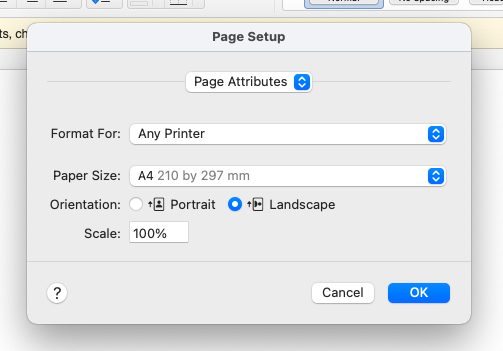
Screenshot of the Page Setup menu on Microsoft Word

Begin by launching Microsoft Word and opening a new blank document. Proper document setup is crucial, so let’s start there.

Navigate to File > Page Setup and choose landscape mode. This will give you enough space for the grid and the clues.

Then, choose an appropriate font for your crossword clues and grid.

Step 2: Building the Crossword Grid

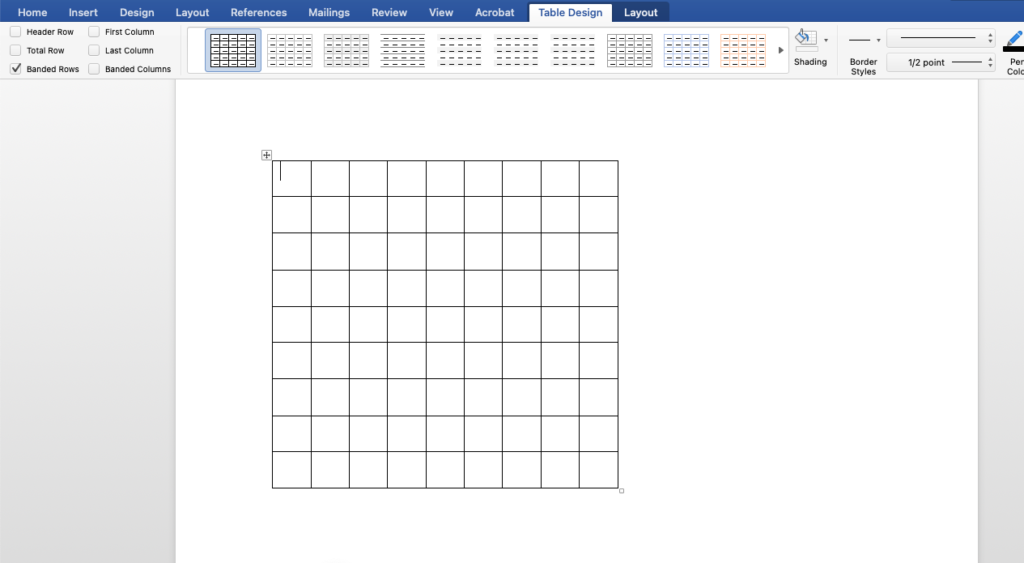
How to Make a Crossword Puzzle in Word: An empty 9x9 table

The crossword grid is the foundation of your puzzle. Follow these steps to create it:

    1. Navigate to the “Insert” tab and select “Table.” Create a square table with the desired number of rows and columns.

    1. Adjust the cell dimensions to create squares of equal size. Drag the table from any corner to adjust height and width. You can also go to Layout (beside Table Design) and add your custom width and height.

Step 3: Adding Clue Numbers and Black Squares

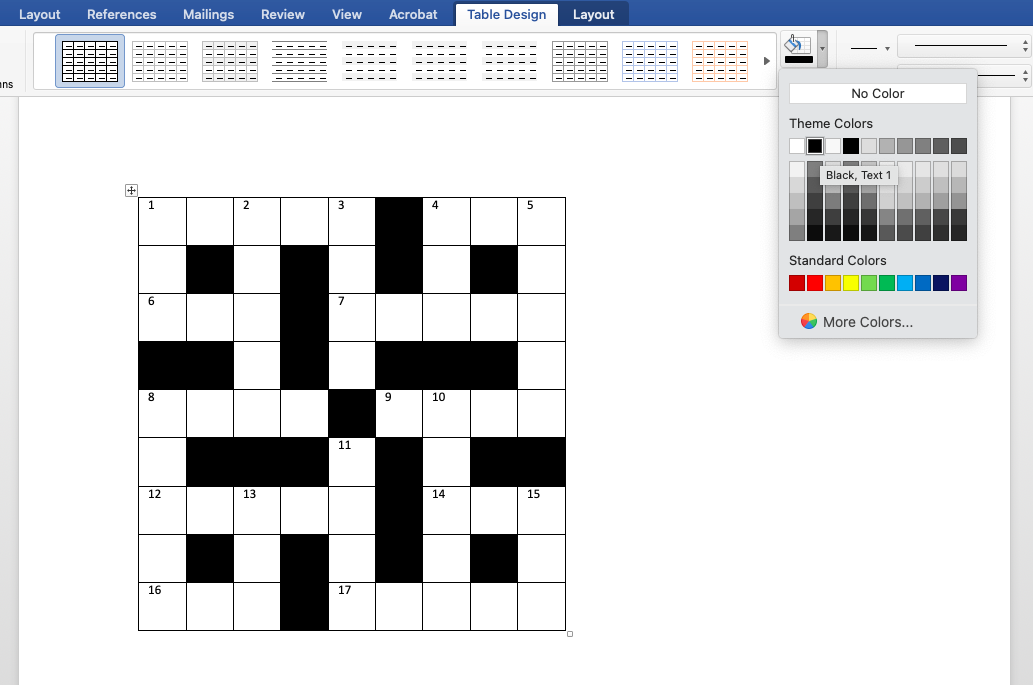
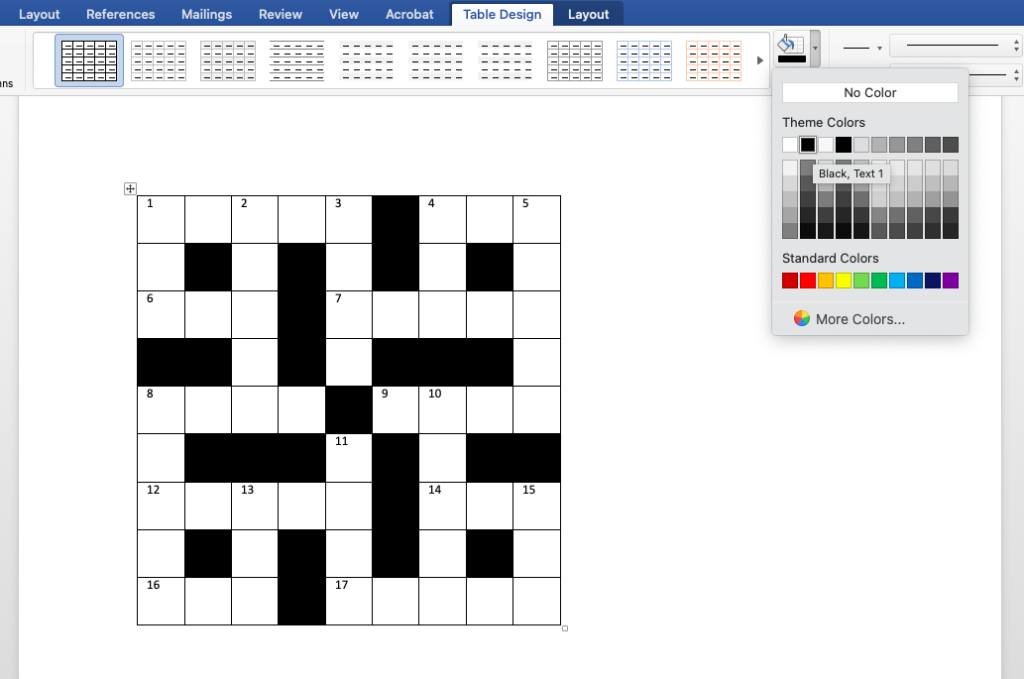
Adding colors to a crossword in word

For the next step in making a crossword puzzle on Word, we’ll need to do two things:

    1. Add numbers: Every square in your crossword grid needs a corresponding clue number. Place these numbers in the upper-left corner of each square, starting from 1 and progressing sequentially.Tip: To make the numbers in the grid smaller, use the keyboard shortcut Ctrl + Shift + Plus (+) and then type in the number in the clue box.

    1. Add black squares: Once the numbers are added, you will want to black out empty squares. To do this, just select the square. Navigate to Table Design > Shading and select the black color.

Once you’ve added all the numbers and empty squares, your grid will start looking like a crossword puzzle!

Step 4: Adding Clues

A crossword puzzle on word with clues

Now, it’s time to infuse your crossword with clues and answers. There are two ways to go about adding your clues when creating a crossword on Word:

The Easy Way

You can just add your clues, one clue per line, below the document. That gives you enough space for longer clues, and you don’t need to do any formatting.

The Hard Way

Here’s how to make your crossword puzzle in word to look professional. You can add your clues to the right of your grid. This will take some work, so gear up:

Follow these steps:

    1. Across clues: Navigate to the first line on the right of the table, and start inputting your across clues in a list.

    1. Show ruler: The complicated part is adding the down clues to the side of the across clues. For this, first, go to View > Ruler.

    1. Add a tab stop: First, select all your across clues. Then, double-click the point on the ruler where you want the down clues to start. This will add a tab stop, which is where we’ll enter the down clues.

    1. Down clues: Go to the end of your across clues and press the ‘Tab’ key. Your cursor will then land on the tab stop, which is where you can enter the Down clues.Enter each down clue by going to the Across clue beside it, and pressing the ‘Tab’ key.

Tip: If you use PuzzleMe for creating crosswords, you will not face any formatting hassles. You can just enter your clues and answers, and PuzzleMe will generate a printable grid with clues that are neatly formatted.

Step 5: Save and Share

Once satisfied with your crossword puzzle, save it as a Word document or in a compatible format for easy sharing and printing.

Now that you’ve successfully crafted your crossword puzzle, it’s time to share it with your intended audience. You can print it out for distribution, send it via email, or even upload it online as a PDF.

Why Choose PuzzleMe to Create Crosswords?

While Microsoft Word offers a versatile platform for crossword creation, there’s a compelling reason to consider using PuzzleMe, an online puzzle maker developed by Amuse Labs. Here’s why:

1. Effortless Formatting and Printing: One of PuzzleMe’s standout features is its seamless PDF printing capability. Say farewell to formatting headaches and complex printing setups. With PuzzleMe, your crossword puzzle will effortlessly convert to a professional-looking, printable PDF format.

2. Free to Use: PuzzleMe is entirely free for hobbyists and indie constructors, making it an accessible tool for creators of all backgrounds. No hidden fees, tiered pricing, or limited features to worry about.

4. An online player: Once you create a crossword on PuzzleMe, you’ll be able to add a playable version of the puzzle to your website or blog. Your solvers will be able to use features like revealing and checking answers, multiplayer, mode, and much more.

In Conclusion

Learning how to make a crossword puzzle in Word can be an enjoyable journey, especially when you follow this comprehensive guide. With the accessibility and versatility of Microsoft Word, you have the tools you need to craft engaging puzzles tailored to your audience.

However, if you’re looking for a solution that offers hassle-free PDF printing, is free to use, and is trusted by top constructors globally, PuzzleMe is the way to go. Try it out, and you’ll quickly discover how it streamlines the puzzle creation process, allowing you to focus on what you do best—crafting captivating crosswords that challenge and entertain. Get started with PuzzleMe today and elevate your crossword puzzles to the next level!